On this page I will discuss the types of "antique" sewing machines we
do not buy, sell, or deal in, and the reasons why. Please read this page before
contacting me about your "antique" sewing machine.
A good rule of thumb for determining
the desirability of any early sewing machine is its serial #.
Early sewing machines (pre 1870) by any maker with a serial # of
under 5,000 would be desirable.
Any sewing machine with a serial # above 50,000 would be considered
"Late" and relatively common. In other words, your Wheeler &
Wilson, Howe, Wilcox & Gibbs, White, Singer, and most other machines
with a serial number in the 6 or 7 digit range is considered common.
It may be antique, but it is also common.
It is important to understand that it is not just
the age, or name that determines the desirability or
value of antique sewing machines. It is a combination of factors,
including the name,
age, style, how many were manufactured, and condition, all taken together that determine the desirability and value.
Again, the simple fact that your sewing machine is old does not mean it is
desirable or valuable.
Later common sewing machines like this have value, but we do not buy or deal in them.
They are usually sold as decorative pieces rather than to collectors of sewing
machines. Later common sewing machines are going to be worth whatever you
can sell them for. They do not have a set collector-based
value. On a bad day at a bad auction such machines can sell for
well under $100. On the other hand, some designer might be able to charge their
client $500 - $1000.00 or more. Bottom line for selling such machines is how
good a salesperson are you, along with the questions of how much is
your time and energy worth?
Still curious, read on.
Antique
sewing machines with high serial #' can come with a host of different
names, and most were made by the three major sewing machine makers and
then sold to and distributed by companies
like Sears, Montgomery Wards, or other large regional distributers across
the country back in the late 1800's / early 1900's.
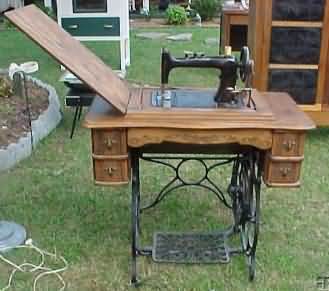
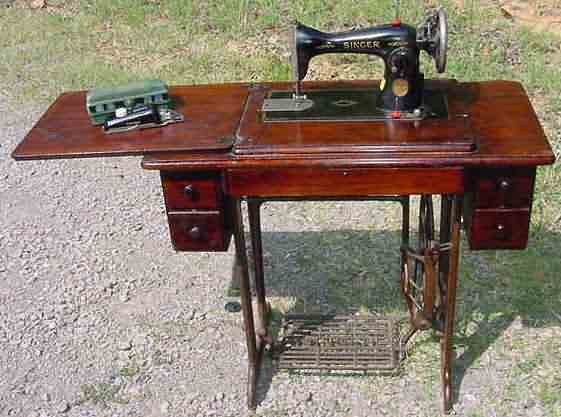
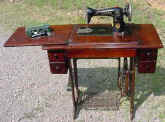
Just below are two pictures of typical
looking later treadle sewing
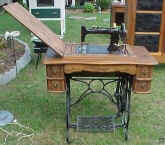 machines. Note the standard looking shape or form of the main body or
head on these machines.
machines. Note the standard looking shape or form of the main body or
head on these machines.
Sewing machines like this typically date from the 1880's or later.
They were sold for $10-$20 back then, and nearly every household had one or more. Much like cars and
other consumer items that are sold today, Sears wanted to sell a new one to the modern seamstresses / housewife,
not once, but every year or two. They would constantly change the name or cosmetic look of their
sewing machines to try and accomplish that.
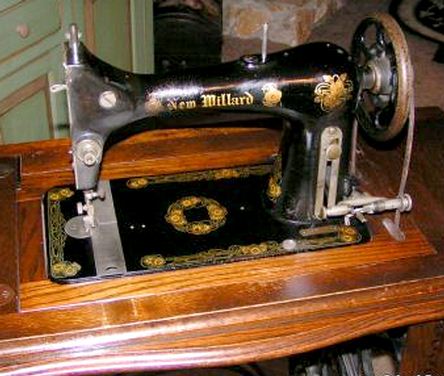
Regional distributors, like Sears,
Wards, Simmons Hardware, etc. would pick whatever name suited them or their goals
for that year. Hence machines are found with names like Household,
 Favorite,
Remington, Winchester, Domestic, Minnesota, Alliance, Victory, Free, and a host of other names can
be found on the same design machine.
Favorite,
Remington, Winchester, Domestic, Minnesota, Alliance, Victory, Free, and a host of other names can
be found on the same design machine.
Companies like Sears or Montgomery Wards and other regional distributors
would also use famous peoples' names in an effort to promote their machines. You can find machines with names like Washington, Lincoln,
Franklin, Edison, Westinghouse, Remington, and others on machines that are pretty much exactly
the same. At other times they picked Patriotic names like
Victory, Defiance, or whatever.
It is called marketing. Bottom line, the large sewing machine makers sold the same
sewing machines to different distributers to be sold as any given
firms house brands with whatever name that distributer chose or wanted.
To see earlier, rare, and more desirable sewing machines
simply go through the past sales archives linked on
the right to get an idea of what collectible antique sewing machines look like.
Free Appraisal
/ Valuation Information
for Later Vintage
Sewing Machines
These later treadle sewing machines do have a value,
and it could be substantial if you have a good buyer and are a good
salesperson.
I have seen
appraisals for and price tags on common treadle sewing machines like
the ones pictured here as high as $4,000. I have also seen
them sell at auction for as low as $10.
Most end up selling for $100 or less. Many are donated to
Hospice or Goodwill and a tax write-off taken.
Their true value is in the eye of the beholder and / or buyer. Basically these later
typical treadle sewing machines are worth what a willing buyer will
pay for them. In the past these
sewing machines were often torn apart for the stands or drawers and
sold for more as parts and the pieces of furniture created than they would
fetch as whole sewing machines.
The basicrule of thumb is: If it looks like your sewing machine, or if
you remember your Mom using it, or nowadays even if your Grandma
bought it, or it has a serial # with 6 or more numbers, it will probably
hold little interest to, or value to, serious or advanced sewing machine collectors.
To see the wide range of current values
for these sorts of sewing machines simply go to eBay and type the name
of your sewing machine in the Search window provided. If there
is nothing similar there this week, try again next week, or try searching
"antique sewing machine" or "vintage sewing machine" or "treadle sewing machine".
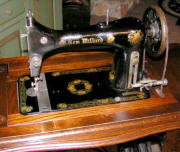 While there be sure to look through completed sales and not just
dealers current asking prices. There is a world of
difference. Also disregard most of the high prices as they are
FAKE, as in Fake News.
While there be sure to look through completed sales and not just
dealers current asking prices. There is a world of
difference. Also disregard most of the high prices as they are
FAKE, as in Fake News.
I guarantee comparable or similar sewing machines have been listed there in the past 30 days.
The fact that most typical "antique" sewing
machines are sitting there with no bids and are listed for sale over
and over speaks volumes as to their demand, desirability
and value. It also has a lot to do with the cost of shipping
and the amount shipping will add to the cost. The point is, if you have a
later more common machine you should be thinking about selling it locally.
If you are not really trying to sell it, and just want a value, look in your local antique shops where
there are likely similar machines, and you can tell yourself that yours
is worth about the same as long as you do not ask the shop owner or dealer what
he will give you for yours.
If after reading this you are still unsure about
your sewing machine send me one picture and an indication that you
read this page and I will give you my opinion,
just do not be offended if I say it is not for me and
refer you back to this page for the reason.
Later Full Size
Electric Sewing Machines
We are
NOT interested in typical looking electric sewing machines that date
from after 1880
EXCEPT the Singer Model 221 or 222 Featherweights.
To find the value for other later electric
sewing machines simply go to eBay and run a few searches there.
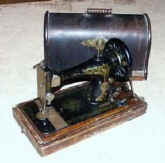 If your electric sewing machine is not listed and you can not find any info with a Google search,
assume it is because it is so common and commands such a low value
that no one bothers to write about them, or to list them. Do not
assume that it is rare, desirable or valuable. For example Vintage Electric Sewing Machines made in Japan after WWII hold near
zero resale value and most sellers do not even bother trying to list them.
If your electric sewing machine is not listed and you can not find any info with a Google search,
assume it is because it is so common and commands such a low value
that no one bothers to write about them, or to list them. Do not
assume that it is rare, desirable or valuable. For example Vintage Electric Sewing Machines made in Japan after WWII hold near
zero resale value and most sellers do not even bother trying to list them.
If you have a Singer featherweight 221 or 222
sewing machine that you would like to sell please click this link to
see my information page: Singer
Featherweights.
BACK to Sewing Machines
* * * * We Buy & Sell Antiques! * * * *
If you have a single antique, or a collection of antiques to sell
please contact us at AntiqBuyer@gmail.com giving us your PHONE NUMBER
and other contact info and we will get back to you ASAP.
To view examples of antiques and collectibles we have previously
sold please visit our
Past
Sales Archive Pages. Links to those pages are on the right.
Thank you!!
Larry & Carole
 Larry & Carole Meeker