I buy, sell, and deal in
antique surveying instruments and science and technology
related antiques.
 In addition to this informational antique website we operate
www.Patented-Antiques.com
where we conduct sales of surveying instruments and other patented, and mechanical antiques.
That antique sales website is one of the largest single owner antique
sales websites on the internet, dealing in surveying related antiques
and other tool and technology related antiques.
In addition to this informational antique website we operate
www.Patented-Antiques.com
where we conduct sales of surveying instruments and other patented, and mechanical antiques.
That antique sales website is one of the largest single owner antique
sales websites on the internet, dealing in surveying related antiques
and other tool and technology related antiques.
If you have surveying instruments or other related tool & technology
related antiques to sell contact us via
email.
This page deals primarily with Antique Surveying
Transits discussing different makers, and variations in designs offered.
Please visit the other specific pages on this site dealing with
surveyor's compasses or
surveying levels
if that is what you have.
There is also additional information and
past sales results
for many surveying instruments in the sales archives found in the right
column if you are looking for values.
Early Transits / Theodolites
William Young of PA is credited with first introducing the idea of a surveyors
transit in the mid to early 1800's by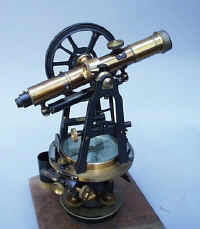 incorporating features of a standard surveying compass and surveying levels with scopes to create one instrument.
That attribution is open to discussion and others have been proposed as
the original creator. Suffice to say that it was an idea that several
users and makers were thinking about at the same general time in the
early 19th century.
incorporating features of a standard surveying compass and surveying levels with scopes to create one instrument.
That attribution is open to discussion and others have been proposed as
the original creator. Suffice to say that it was an idea that several
users and makers were thinking about at the same general time in the
early 19th century.
The first transits were referred to as
theodolites. Because of the primitive nature of the optics,
the first transits did not have the ability to turn a full circle within the standards holding the
scope. In other words the scope had to be longer than the height
of the standards. This drawback was soon remedied with improvements to the science of
optics and all makers began making instruments where the scope could revolve in
their standards thus allowing the user to shoot behind him without rotating
the entire instrument. The definition or meaning of the term theodilites has changed over
time with more precise instruments being called by that name later on.
Today, many sellers of surveying related instruments, from simple abneys and levels, and most
anything else with a scope, call their piece a theodolite because they
have found sale results indicating that theodilites are rare and more valuable.
Solar & Mining Transits
Surveyor's transits that have solar
attachments, including scopes, or those equipped with auxiliary
 scopes
used for mining, and those instruments that have other unusual patented
or special use features are unusual, more valuable, harder to find and of special interest.
scopes
used for mining, and those instruments that have other unusual patented
or special use features are unusual, more valuable, harder to find and of special interest.
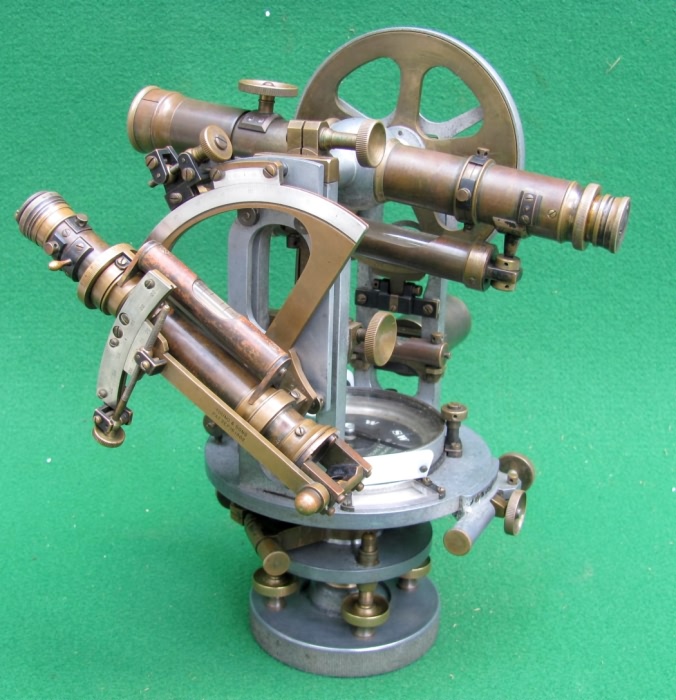
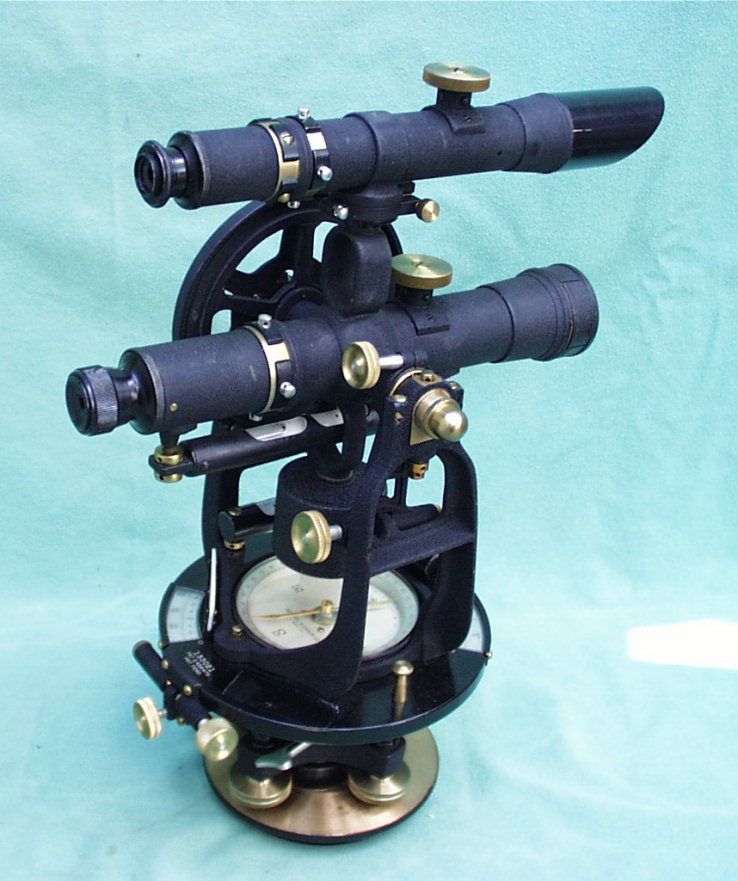
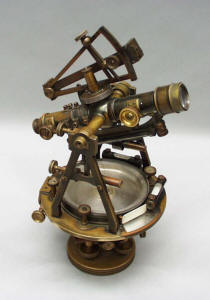
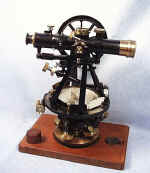
To the right is a Gurley solar transit fitted w/ a Burt patent solar attachment.
This instrument was made by W. & L. E. Gurley near the turn of the 20th century. More info about this
particular instrument can be found by visiting the
Gurley past sales archives and reading a more detailed description.
Different makers developed different patented versions of solar attachments. The Burt solar attachment resembles a tiny sextant affixed to the top of
the instrument. The patent for its design was granted in the 1830's and first applied to compasses.
K & E
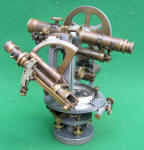 or Keuffel & Esser, Leitz, Buff, and others utilized
a smaller top mounted scope called the Saegmuller solar attachment.
Other patented solar attachments were a side mount scope such as the Smith Patent solar attachment and the Pearson solar attachment.
or Keuffel & Esser, Leitz, Buff, and others utilized
a smaller top mounted scope called the Saegmuller solar attachment.
Other patented solar attachments were a side mount scope such as the Smith Patent solar attachment and the Pearson solar attachment.
This idea was also adaptable to compasses, and solar compasses are one of the
most desirable and rare of all surveying instruments that were produced and I
currently have an early Aluminum Solar Compass being offered for sale on
our sales website
www.Patented-Antiques.com.
Condition / Vintage
Antique surveying instruments in original undamaged condition
are always worth more than those that are damaged or
 have seen extensive use and abuse. In general the earlier an instrument the more
desirable it is, and those from the early to mid 1800's are becoming increasingly harder to find.
have seen extensive use and abuse. In general the earlier an instrument the more
desirable it is, and those from the early to mid 1800's are becoming increasingly harder to find.
Most surveying instruments from after WWII are later than what most collectors of antique surveying
instruments are looking for. Most of these later surveying instruments sell to casual users
or beginning collectors. As evidenced by sales results at eBay, instruments from this era hold little collector interest or value.
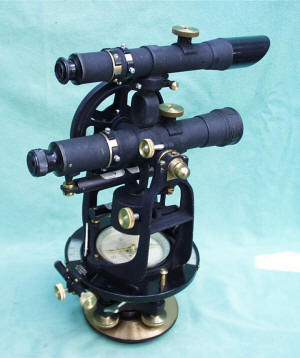
Antique surveying instruments come in a variety of finishes ranging from natural brass
and
 clear or colored lacquer to
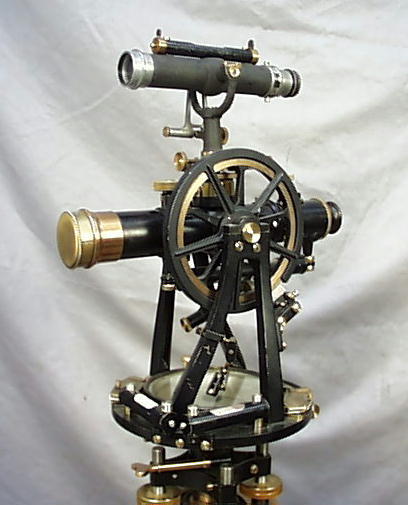
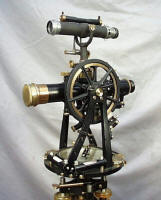
smooth or crinkle painted surfaces usually found on later instruments. Some instruments have anodized
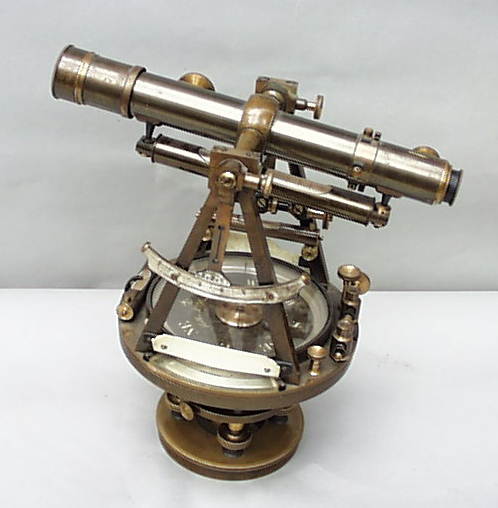
finishes to help keep down the glare like the instrument to the left.
clear or colored lacquer to
smooth or crinkle painted surfaces usually found on later instruments. Some instruments have anodized
finishes to help keep down the glare like the instrument to the left.
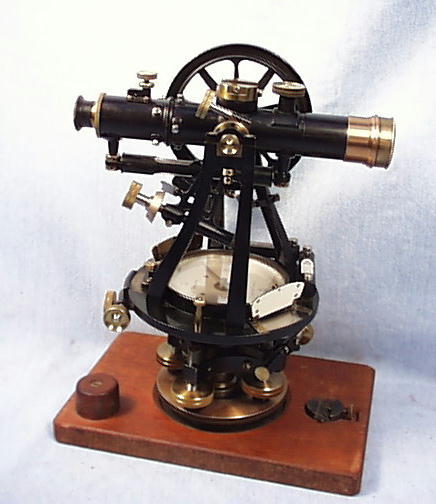
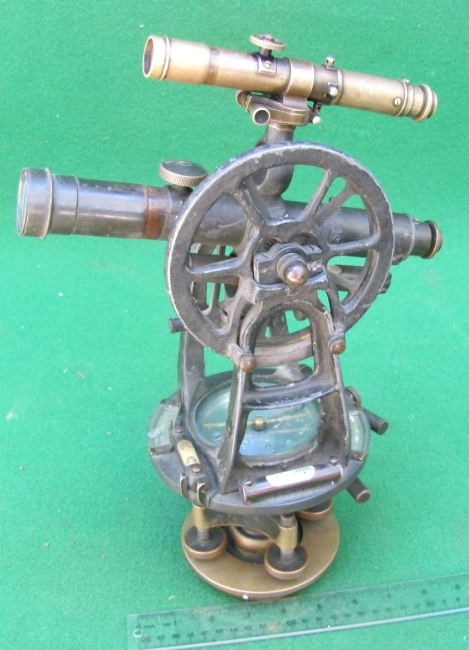
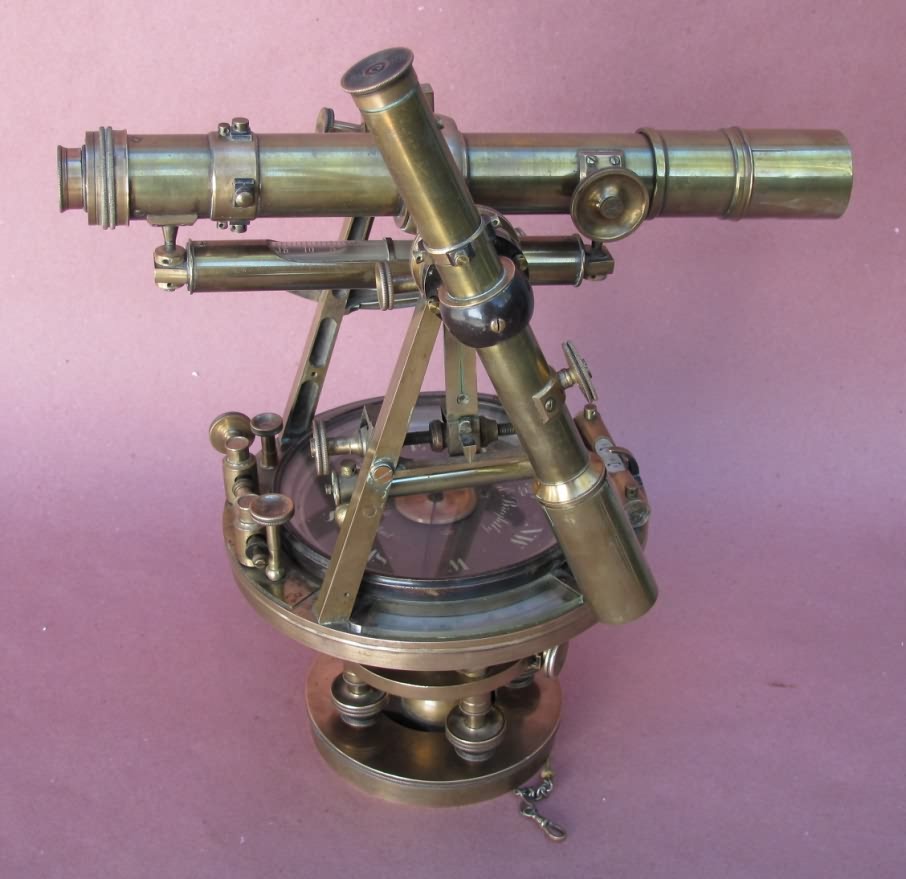
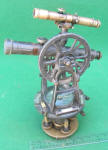
Just above is a K & E Solar Transit w/o its solar attachment. Note that
this transit has an adapter fitting on the top to accept a solar
instrument. The transit to the right is shown with its attachment
showing what a Saegmuller Attachment looks like. The sextant looking
affair patented by Burt that Gurley used on Gurley transits is pictured
above. That missing auxiliary scope accounts for half or more of the
value of an instrument like this.
Transit Types
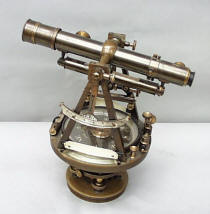
Transits with 6" scopes are typically referred to as as Explorer
or Expedition models. Instruments
 with 8" scopes are usually designated as Light Mountain or Preliminary transits.
10 - 12 inch scopes are called architects or engineers transits
depending on features they exhibit like vernier scales or
compasses beneath the scope. Instruments with small magnifiers positioned
over the very fine vernier scales are referred to as theodolites today.
with 8" scopes are usually designated as Light Mountain or Preliminary transits.
10 - 12 inch scopes are called architects or engineers transits
depending on features they exhibit like vernier scales or
compasses beneath the scope. Instruments with small magnifiers positioned
over the very fine vernier scales are referred to as theodolites today.
If you have an antique surveying instrument that you are looking to sell contact
me. Telling me you have a Gurley, Berger, Buff, Buff & Buff, K & E, Aloe, David White, etc. and just giving me the
serial number is not enough information to determine what it is you have, or what it might be worth. The details are what
determines the value or interest.
Asking me what your transit is worth without
seeing it would be like me asking you what my car is worth, without me telling you anything
more about it
 then that it is a Toyota or Chevrolet. In most cases it simply can not be done with so
little information.
then that it is a Toyota or Chevrolet. In most cases it simply can not be done with so
little information.
The list of surveying instrument makers whose pieces are of interest is extensive, and
starts with such famous makers as David or Benjamin Rittenhouse, who made instruments during
George Washington's time, to the more well known and prolific makers like W. E. Gurley,
Lietz, Buff, Berger, Heller & Brightly, Keuffel and Esser, Roach,
Sala, or Queen & Co. to name just a few. There are numerous makers of surveying instruments that have normal given
names that were in business for varying periods of time in the 19th
century. The list of individual maker names is extensive and can not
really be given here but there is interest in many of these lesser known
makers and their instruments as well.
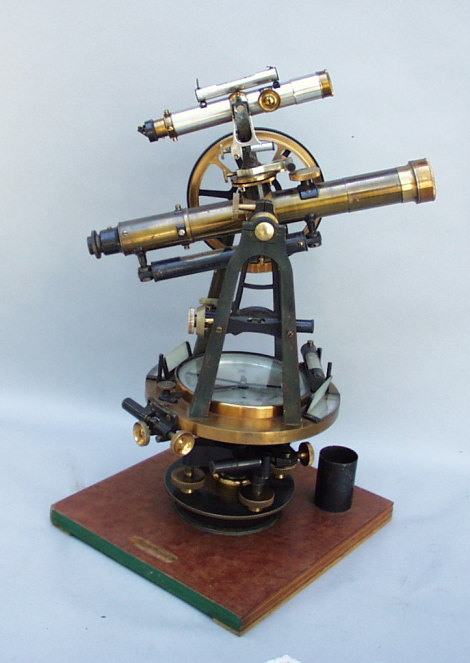
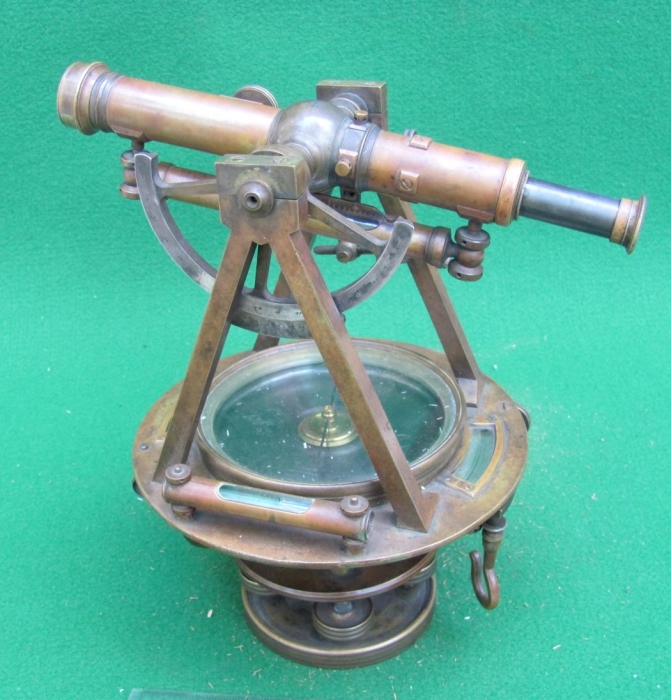
The surveying instruments
described and show are examples of the
caliber, condition and quality of antique
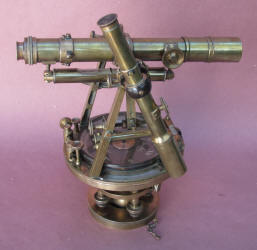 surveying instruments and equipment that I am primarily
interested in.
surveying instruments and equipment that I am primarily
interested in.
If you have quality antique surveying instruments that you want to sell, please contact us at
AntiqBuyer@gmail.com providing me with as many details as possible.
To see many examples of surveying instruments and other scientific related antiques that we
have sold in the past please see the relevant links in the right column or
click here.
To see examples of antique transits and other surveying
instruments that we currently have for sale, please go to our sister site
at www.Patented-Antiques.com and
visit the sales pages you will find there.
Thank you!!
Larry & Carole
 Larry & Carole Meeker